
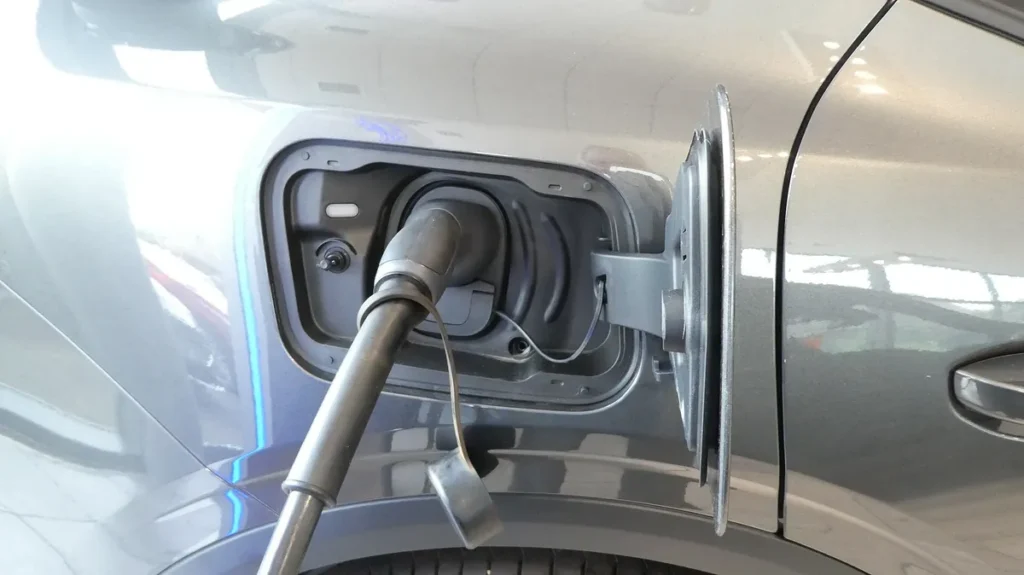
Photo: Pamsimhaho, Wikimedia Commons (CC0). A generic EV, not the Tesla Roadster.
Tesla showed its new Roadster on 15 October 2026 (US time). Tesla says its active rear wing is moved by the same actuators Tesla builds for its Optimus humanoid robot. Like every EV, it has no engine oil, no oil filter and no spark plugs. So does a car like that need lubricants at all? Yes, quite a few.
One thing first: Tesla has not published any fluid specifications for the new Roadster. This is not a Tesla spec sheet. It’s a tribologist’s view of the types of fluids and greases a high-performance EV needs, and why. Where we say how current Teslas do it, we quote Tesla’s own Model 3 and Model S service manuals.
Six fluid and grease systems in an EV at a glance
| System | Fluid or grease type | Why it matters | Service guidance |
|---|---|---|---|
| Drive unit / e-axle | Low-viscosity EV gearbox fluid | Gear protection, motor cooling, copper and electrical compatibility | As the maker specifies; never substitute ATF or gear oil |
| Battery / motor loop | The maker’s glycol-water coolant (some designs use dielectric fluid) | Heat control, corrosion, electrical safety | As specified; never mix types; don’t add water unless the maker says so |
| Brakes | Glycol DOT 4 / DOT 5.1, as specified | Boiling point, corrosion, sticking pistons | On time and test result, not km; more often in humidity or track use |
| A/C / heat pump | The maker’s refrigerant and the compressor’s labelled oil | Insulation of the high-voltage compressor | Only the labelled oil; EV-rated equipment |
| Wheel bearings / CV joints | Sealed hub grease; CV grease | Full torque from zero rpm, dust | Inspect boots and bearings every service |
| Actuators / small gears | Special-purpose greases | Cold torque, plastic compatibility, noise, long sealed life | Usually sealed for life; follow the maker |
1. EV gear oil: drive unit and e-axle fluid
An EV’s motor spins at very high rpm and sends big torque through a compact reduction gearbox. In many designs the same oil also cools the motor. Tesla’s Model 3 drive units have their own oil pump, oil filter and heat exchanger, and use a dedicated gearbox fluid, currently listed as KAF1.
What this fluid has to do:
- Stay thin, yet protect the gears. Low viscosity cuts churning losses and carries heat away. But a thin film on heavily loaded, fast gear teeth risks scuffing and micropitting, so the additives have to make up for it.
- Behave electrically. If the oil touches windings, its conductivity matters: low enough to avoid current leakage, but enough to bleed off static.
- Be kind to copper. Some classic sulphur-based gear-oil additives attack copper, even as vapour. EV fluids are made to protect copper windings, insulation, seals and plastics.
- Not foam, because aerated oil cools and lubricates badly at high motor speeds.
- Help against electrical bearing damage. Stray currents from the inverter can pit motor bearings. Fluid choice helps, but grounding and bearing design do most of the work.
Workshop tip: never top up an EV gearbox with “any ATF” or a GL-5 gear oil. Use exactly the fluid the manufacturer lists.
2. EV coolant: battery and motor loop
The battery, inverter and motor sit in a liquid-cooled loop, and most production EVs use a glycol-water coolant. For the Model 3, Tesla specifies an “ethylene glycol (phosphate and nitrate free)” coolant, G-48, as a 50/50 premix. The manual says “Do not add water” and that glycol should stay between 50% and 60%. Tesla warrants only G-48.
- Electrical safety. The coolant runs through cold plates right next to high-voltage parts. That’s one reason EV makers specify their own coolant and tell you exactly how to mix it.
- Aluminium corrosion. Thin aluminium cold plates and pumps need the right inhibitor chemistry.
- Never mix coolant types. Different inhibitor packages can drop out as sludge and block fine cooling channels.
- Dielectric immersion fluids are a separate, newer technology: non-water fluids that touch the cells directly. They can’t be mixed with, or swapped for, glycol coolant.
SA tip: a heavy-duty diesel coolant does a great job in a truck, but it isn’t specified for an EV battery loop. Use the vehicle maker’s coolant.
3. EV brake fluid in South Africa: used less, ageing just the same
Regenerative braking means an EV’s friction brakes may hardly work in daily driving. That sounds like good news, but it isn’t. Glycol DOT 4 and DOT 5.1 brake fluids absorb moisture from the air over time, whether you brake or not. Water lowers the boiling point and encourages corrosion in callipers and ABS valves, and pistons that seldom move are more likely to stick.
- How current Teslas do it: the Model 3 service manual says “DOT 4 BASF Hydraulan 404 … is the approved brake fluid”. Model S Plaid with the carbon-ceramic brake kit uses a high-performance DOT 5.1 (BASF Hydraulan 406 ESI).
- Tesla recommends a brake fluid test every 4 years, replacing it if needed, and more often for heavy braking, performance driving or hot, humid climates. Its check uses a test strip for corrosion (copper), not a kilometre count.
- Tesla’s owner’s manual says “Do not top up your brake fluid”, and leaves brake fluid and battery coolant checks to Tesla or a professional.
- Track use is a different world. Tesla says the Roadster’s aero approaches “F1 levels” of downforce. Any car cornering that hard heats its brakes hard, and fresh fluid of the specified grade becomes a safety item.
Our guidance: service brake fluid on time and test result, not kilometres. At the coast, or if the car is tracked, test it more often than the minimum.
4. A/C and heat pump: the oil you didn’t know about
EVs use an electrically driven A/C compressor. Its high-voltage motor windings sit inside the refrigerant and oil circuit, so the compressor oil has to insulate as well as lubricate.
- Refrigerant: current Teslas use R134a or R1234yf, depending on the sales region.
- Oil: Tesla specifies the oil by compressor make (RB100EV or ND-11) and says “Do not mix different types of A/C system oil.”
- The big risk: conventional PAG oil absorbs moisture. The Australian Refrigeration Council warns that “even 1% of PAG oil in the electric compressor will reduce the compressor insulation resistance from 10 megohms to 1 megohm”, and the compressor body can become live.
Workshop tip: use EV-rated or properly flushed A/C equipment, use exactly the oil type on the compressor label or in the manual, and only use a leak-detection dye the vehicle maker approves.
5. Wheel bearings, CV joints and halfshafts
An electric motor delivers full torque from zero rpm, so at launch the CV joints and wheel bearings take a torque spike before there’s speed to build a good lubricant film.
- Wheel bearings are usually sealed-for-life hub units with high-temperature grease. There’s nothing to re-grease: check for noise and play, and replace the unit when worn.
- CV joints use dedicated CV greases, often with molybdenum disulphide. A torn boot lets our SA dust and grit in and the grease out, and the joint usually fails soon after.
Tip: check CV boots at every service, especially on gravel-road cars, and use the grease supplied with the boot kit.
6. Actuators, gears and small mechanisms
Modern EVs are full of small electric actuators: windows, seats, electric steering, charge-port flaps and active aero. Their greases need low torque in the cold, compatibility with plastic gears and seals, and low noise, because in a quiet EV every squeak is heard.
Do robot-style actuators, like the Roadster’s wing, use lubricant?
According to Tesla, the Roadster’s wing is driven by its Optimus actuator system. That’s reported by Electrek and EVXL, and by TeslaNorth, citing Tesla VP Lars Moravy in a Hagerty interview. Tesla hasn’t said which actuator type the wing uses or what lubricant is inside, so we won’t guess.
In general, though, robot-style electromechanical actuators are lubricated, almost always with grease rather than oil:
- Strain-wave (harmonic) gears, which Tesla showed in Optimus’s rotary joints at its 2022 AI Day, run on special-purpose greases, often synthetic. Harmonic Drive, for example, lists both mineral-oil lithium greases with molybdenum and a synthetic urea grease.
- Planetary roller screws, which Tesla showed in Optimus’s linear joints, normally run on an EP grease. Makers such as Rollvis advise relubricating only with the same type.
Why grease? It stays where it’s put, needs no sump or pump, and helps seal out dust and water. Mixing in a different grease risks thickener incompatibility, softening and leaks.
How AVDMM can help
AVDMM has supplied lubricants to South African workshops, fleets and industry since 1986. We can help you read the fluid specifications in your vehicle manual and source the right product.
For brake fluid, Havoline Brake and Clutch Fluid DOT 4 comes in 250 ml and 500 ml packs. Per its product data sheet, “Brake and Clutch Fluid DOT4 meets the requirements of the following specifications: U.S. Federal Motor Vehicle Safety Standard FMVSS No. 116 DOT4 and DOT 3; SAE J1704 and SAE J1703; ISO 4925 (Classes 3 & 4); JIS K2233-95 (Types 3 & 4); NATO specification H-542 (OX-8).” It is not a Tesla-approved fluid. For any vehicle under warranty, use the fluid the maker lists. The PDS is on our data sheets page.
For other fluids, see the brands we supply, or read our guide to the new API SQ and ILSAC GF-7 standards if you also service hybrids.
Frequently asked questions
What fluids does the new Tesla Roadster use?
Tesla has not published fluid specifications for the new Roadster. Current Teslas use a dedicated drive-unit fluid, G-48 glycol coolant, DOT 4 (or DOT 5.1 on some performance brakes) brake fluid, and R134a or R1234yf refrigerant depending on region.
Do electric cars need oil changes?
There’s no engine oil, but EVs still have a gearbox fluid, a coolant, brake fluid, A/C compressor oil and several greases. Follow the maker’s service schedule for each.
Can I use normal coolant in an EV battery loop?
No. Use the coolant the vehicle maker specifies. For the Model 3, Tesla specifies G-48, a phosphate- and nitrate-free ethylene glycol premix, and says not to add water.
How often should EV brake fluid be changed?
On time and test result, not kilometres. Tesla recommends testing every 4 years, and more often for performance driving or hot, humid climates.
Can I use ATF or gear oil in an EV gearbox?
No. EV drive units need the specific low-viscosity fluid the manufacturer lists, because the fluid may also touch motor windings and copper parts.
Is Havoline Brake and Clutch Fluid DOT 4 approved for Tesla?
No. Its PDS says it meets FMVSS No. 116 DOT4, among other specifications, but it is not Tesla-approved. Use the fluid your vehicle maker lists.
Ask our team
Call 011 422 1333 · WhatsApp +27 83 252 0540 · Contact our Benoni counter (27 Liverpool Road, Benoni)
This article is general technical guidance, not a manufacturer specification. Tesla has not published fluid specifications for the new Roadster. Always follow your vehicle manufacturer’s manual and use the fluids it specifies, especially under warranty. High-voltage systems must be serviced only by trained, qualified technicians. Tesla and other OEM names are used for reference only.