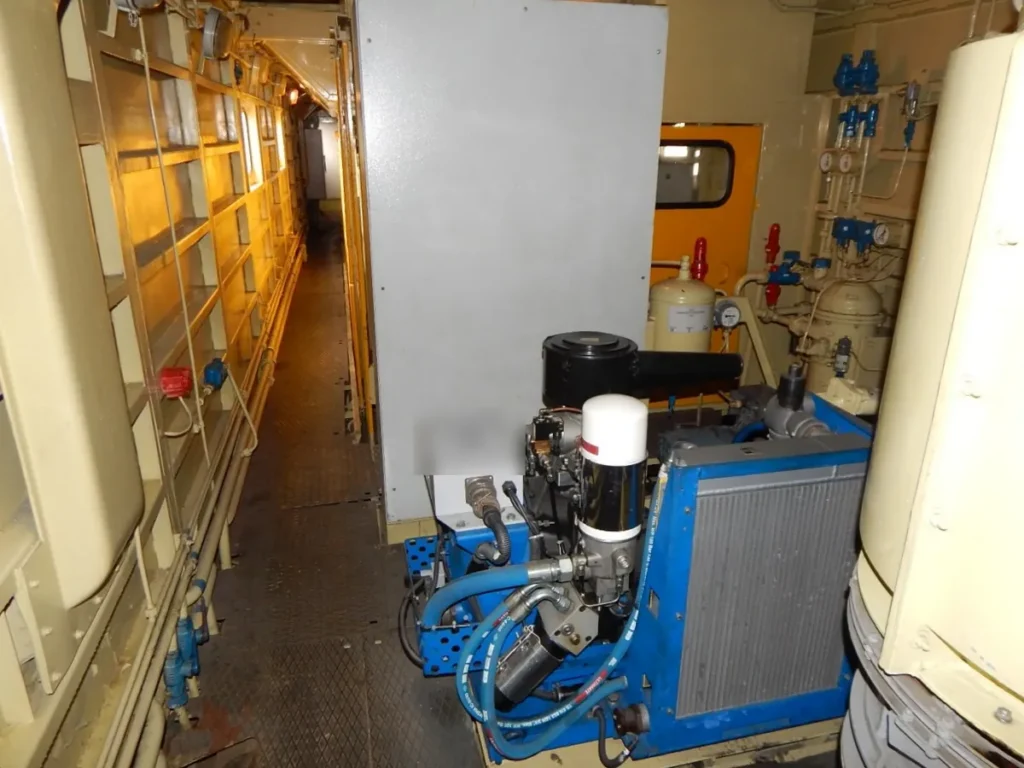
Photo: Павел (trainpix.org), Wikimedia Commons (CC0). A generic compressor, not a Castrol product.
The oil inside an air compressor works hard. The wrong grade, or an oil that can’t take the heat, shows up as carbon on piston valves, varnish in screw elements, blocked separators and expensive call-outs. This is a plain-English guide to Castrol Aircol compressor oils: which grade suits which machine, and when synthetic is worth it.
First rule: follow your compressor maker’s recommendation. Castrol’s own data sheet says grade selection “should be based upon the compressor manufacturers’ recommendation”. Use this guide alongside your manual, not instead of it.
Two families: Aircol CM (mineral) and Aircol SR (synthetic)
Castrol Aircol CM is “based upon highly refined mineral oil”, with additives for thermal and oxidation stability and load-carrying. It is “formulated without zinc additives (ashless oils)” and comes in ISO VG 32, 46, 68, 100 and 150. Castrol classifies it under ISO 6743-3 as DAA and DAB for piston and drip-fed rotary air compressors, and DAG and DAH for oil-flooded rotary screw air compressors. Its data sheet says it meets “the requirements of the DIN 51506 VDL classification for reciprocating compressors having air discharge temperatures up to 220°C”. The South African data sheet lists no compressor-maker approvals.
Castrol Aircol SR is “based on polyalphaolefin (PAO) fluids” and ester-free. It’s for oil-flooded rotary screw compressors in severe conditions where “very high air discharge temperatures (> 100°C) are experienced”, and also for normal duty. Castrol lists it under DIN 51506 VDL and ISO 6743/3 DAG, DAH and DAJ. The data sheet says Aircol SR grades “meet the requirements of: Atlas Copco 8000 hour oil drain interval · Kaeser”. That is the maker’s wording, not an approval, so if your compressor is under an OEM service contract, ask us before you switch.
Which Aircol grade for which compressor?
| Compressor type | Typical Aircol choice (per Castrol PDS) | Notes |
|---|---|---|
| Oil-flooded rotary screw, normal duty | Aircol CM 32 or CM 46 | Designed for drains of up to 4,000 hours when running continuously at discharge up to 90 °C |
| Oil-flooded rotary screw, hot or severe duty (discharge > 100 °C), or longer drains | Aircol SR 46 (PAO synthetic): ask us | Up to 8,000 hours under normal operating conditions |
| Piston (reciprocating): crankcase and cylinders | Aircol CM 68, CM 100 or CM 150 | Meets the requirements of DIN 51506 VDL up to 220 °C discharge |
| Piston at high ambient temperatures | Aircol CM 150 | Per Castrol’s general guide |
| Sliding-vane | Aircol CM 150 | Recommended in the Aircol CM PDS |
| Geared compressor units | Aircol CM (grade per OEM) | PDS: “high FZG load carrying is designed also to meet geared compressor units” |
| Centrifugal (dynamic) | Ask us | Not covered by the Aircol CM or SR data sheets. Follow the OEM spec |
Pack sizes: Aircol CM 32, 46, 68, 100 and 150 in 20 L, and CM 68 also in 210 L. Aircol SR 46: ask us.
Mineral or synthetic: what changes?
Heat and oxidation
Hot oil oxidises: it thickens, turns acidic and leaves deposits. Castrol’s typical RPVOT (ASTM D2272) figures show the gap: Aircol CM 46 at 1,530 minutes and Aircol SR 46 at 3,000 minutes. Higher means more oxidation-resistant. These are typical values, not specifications.
Carbon and varnish
In piston compressors, oil that breaks down on hot discharge valves forms carbon, which makes valves stick and leak. Aircol CM is described as having “low carbon forming tendencies”, and Castrol says its low volatility and low carbon formation “reduces the risk of fire and explosion”. That reduces a risk; it doesn’t make the oil non-flammable. In screw compressors the same breakdown shows up as varnish and sludge in separators and filters.
Discharge temperature decides
Aircol CM is designed for drains of up to 4,000 hours in screw compressors running continuously at discharge up to 90 °C. Above 90 °C, Castrol says the compressor maker’s standard oil change periods should be used. Aircol SR is made for discharge above 100 °C as well as normal duty.
Drain life
Under normal operating conditions, Aircol SR “can be used for extended drain intervals up to 8000 hours”, typically “depending on the operating environment”. Fewer changes mean less downtime and less waste oil, but only if oil analysis confirms the oil is still in good condition.
Flash point and water
Typical open-cup flash points are 223–240 °C for Aircol CM and 264 °C for Aircol SR 46. Both data sheets describe good water separation, which matters because oil that holds water in an emulsion can block the separator and cause rust.
Switching from mineral to synthetic
Castrol says Aircol SR’s PAO base gives “good compatibility with seals and mineral oil based lubricants, allowing changeover to Aircol SR without compatibility issues.” Before you change:
- Check your seals. Aircol SR is compatible with nitrile, silicone, polyurethane and fluoropolymer seals, but not with SBR or EPDM seals.
- Drain hot and drain fully, including the cooler and lines where you can. Change the oil filter and separator element per the OEM schedule. If the old oil was badly oxidised or varnished, ask us about a flush first.
- Sample soon after the change so you can see how the new oil is behaving.
What shortens compressor oil life in South Africa
- Heat. Summer plant rooms run hot, and hot intake air means hotter discharge. Ventilate the room, keep cooler fins clean and watch discharge temperature. If it regularly runs above 90–100 °C, talk to us about synthetic.
- Dust. On mines, quarries and dirt yards, dust that gets past the intake filter becomes an abrasive in the oil. Change intake filters on condition and check the housing seals.
- Condensate. Compressing humid air makes water, especially in summer thunderstorm season. Check that receiver and separator drains work.
- No oil analysis. Sample at the interval your OEM or lab suggests. Watch viscosity change, acid number, water, oxidation, and wear metals and silicon (dust). The trend tells you when to change the oil, before the separator tells you the hard way.
Oil analysis and on-site checks from AVDMM
AVDMM offers oil analysis and on-site checks for our customers. We can sample your compressor oil, help you read the results and check filters, drains and oil condition on site. Ask us to set it up for your compressors.
Quick checklist
- Check the compressor manual for the ISO VG and oil type.
- Screw, normal duty: Aircol CM 32 or 46.
- Screw, hot or long-drain: ask us about Aircol SR 46.
- Piston: Aircol CM 68, 100 or 150 (CM 150 at high ambient temperatures).
- Vane: Aircol CM 150.
- Centrifugal: ask us, and follow the OEM spec.
- Keep intake filters, coolers and condensate drains in order, and sample the oil.
Working with pneumatic rock drills too? See our guide to Castrol Magna RD rock drill oils.
Refrigeration compressors need different oils. See our guide to Castrol refrigeration compressor oils.
Frequently asked questions
Which Castrol Aircol oil for a rotary screw compressor?
Follow the compressor maker’s manual first. As a general guide, Castrol’s PDS lists Aircol CM 32 and 46 for oil-flooded rotary screw compressors, and Aircol SR (PAO synthetic) for severe duty with air discharge above 100 °C. Ask us about Aircol SR 46.
Which Aircol grade for a piston compressor?
The Aircol CM PDS lists CM 68, CM 100 and CM 150 for the crankcase and cylinders of reciprocating compressors, with CM 150 also for high ambient temperatures and sliding-vane compressors.
Is Aircol SR approved by Atlas Copco or Kaeser?
No approval is stated. The PDS says Aircol SR grades meet the requirements of the Atlas Copco 8000 hour oil drain interval and Kaeser. Ask us if your compressor is under an OEM service contract.
Does Aircol CM really last 4,000 hours?
The PDS says it is designed for drains of up to 4,000 hours in rotary screw compressors running continuously at air discharge temperatures up to 90 °C. Above 90 °C, use the compressor maker’s standard oil change periods.
Can I switch from mineral to Aircol SR?
Castrol says changeover to Aircol SR is possible without compatibility issues, but Aircol SR is not compatible with SBR or EPDM seals. Check your seals, drain fully and sample the oil after the change.
Does AVDMM offer compressor oil analysis?
Yes. AVDMM offers oil analysis and on-site checks for customers. Contact us to set it up.
Talk to us about Aircol
Castrol is sold by AVDMM Lubes (Level 2 B-BBEE). See our Castrol range and the other brands we supply.
Call 011 422 1333 · WhatsApp +27 83 252 0540 · Contact us · How to pay
Based on Castrol product data sheets: Aircol CM Range (02 Aug 2021, Castrol South Africa) and Castrol Aircol SR Range (04 Jun 2025). Typical values are not specifications. This is general guidance; always follow your equipment manufacturer’s recommendations.